Picking Up the Pieces of a Broken World: The Holistic Hardware of Earth Repair
Like children who have made their room messy and dysfunctional, we must work to resist the march of entropy. But when our Mother has no hands, who but we will pick up the pieces and make this planet a healthy space for life to thrive again?

As I was gardening the other day, I noticed some large rocks littering the ground at the bottom of a terrace wall. Wondering where they’d come from, I looked upward and saw that they had fallen from the spot where they’d once been carefully stacked to retain the land. That’s no good, I thought – the hill might come apart at the seams. Without those stones, there’s nothing to hold the dirt, the roots, the leaves, or the water that gravity constantly pulls downhill. Of course, I know by now that in restoration work, the goal is to slow these movements down, to let the land breathe and absorb – to let the seeds take root and to let the organic debris to break down and nourish them. But it struck me that had I not noticed this slippage – had I not picked up the rocks and reset them – the slope would’ve kept unraveling.
It reminded me of being a kid, told by your mother to hang up your jacket rather than leave it on the floor to get soiled and ruined. As we grow, we (hopefully) learn to return things to their rightful place – to inject order where entropy would otherwise win, if only to preserve function. As a child, you know somewhere in the back of your mind that if you don’t pick it up, your mom will. But the Earth has no hands itself, at least none large enough to lift the stones and place them intentionally. We must be those hands – after all, we are the ones who messed things up. But where do we draw the line? How much order is enough? Where is our management required, and where does it become meddlesome? How do humans fit into this living tapestry appropriately?
This, I think, is where the real meaning of Earth Repair comes in. We often hear that humans just need to step back and let nature heal itself. And while there’s logic in that – yes, technically, the Earth can and will heal – it also feels like an abdication of responsibility, and given the scale of the problems, one could say it’s downright reckless. Saying “just leave it alone” is like letting an open wound bleed in the hope that the body’s natural clotting will be enough. Sometimes it will, but when the wound is deep, doing nothing can be fatal. The Earth’s surface has been so disturbed that healing now needs a helping hand.
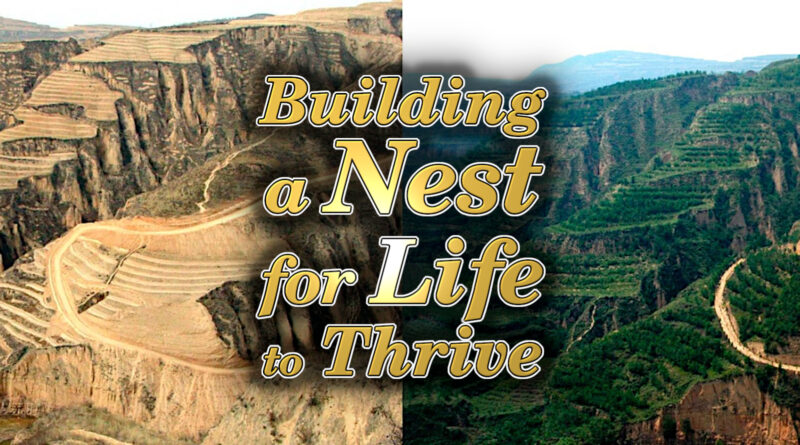
Having soiled and scattered our nest, the cradle of our very existence, we must repair the damage physically, precisely so that Mama can do what she does best and heal. Thankfully, there are precedents everywhere for this kind of work, and the evidence of it stands in many cases to this day. Terraces, check dams, zai pits, stone lines, berms, swales – these are not inventions of the 1970s “back-to-the-land” movement. They are the heritage of Indigenous cultures from the Sahel to the Andes, refined over millennia. These ancient engineers understood how to shape the skeleton of the land so that water, soil, and life could thrive together.
As a gardener might speak of softscape and hardscape, or a technician of software and hardware, I think of Earth Repair as the hardware for life. The “soft” – the seeds, spores, and other biota – depend on stable physical ground to take hold. Ecosystem restoration can happen on its own, but it happens faster and stronger when the land has structure to catch and hold the essentials.
Even though this industrialized global culture is composed of various cultures with their own traditions of caring for the lands and waters, we have forgotten much – and despite these humble origins, for all intents and purposes, this new global “civilization” is as irresponsible as it is immature. The mark of a mature culture, then, is taking the time to “pick up our jacket” – or in this case, to pick up logs and rocks and set them on contour. By taking these actions of deliberate care, we can make homes for organic matter and debris, for animal droppings and fungal spores, for droplets and torrents alike. Each contour we shape slows water, lengthens the journey of every nutrient before it reaches the sea, and enriches everything in between — the land, the rivers, the ocean, even the sky.
Collectively, these actions cascade across watersheds, bio-regions, continents, and indeed the world – reversing the decay of our lands and waters, even bringing regulation and regularity back to the climate as a whole.
The Earth will endure either way; ecosystems will continue in some form or another. What matters is how rich or poor we allow them to become. Humans are part of nature, and vice-versa, and the interactions therein define the quality of life around us. Indigenous stewardship throughout time has shown this truth clearly: vibrant and intentional co-creation, not withdrawal, sustains the tapestry of this living world. Shying away from our roles will not serve us anymore – it’s time to grow up and meet our collective destiny – it’s time for Earth Repair.