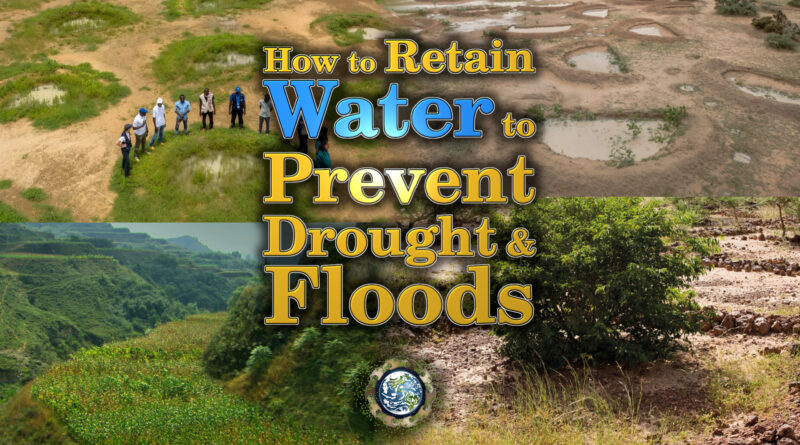
Water Retention & Flood Prevention
We will most likely have a panel on Water Retention & Flood Prevention at the Global Earth Repair Convergence on May 8-10. 2026. Some participants in the panel will be at the in-person convergence and some will join them using Zoom. I will be inviting Andrew Millison, Zach Weiss and Darren Doherty to be on the panel as well as others.
The world at this time is having major flooding in more and more places. Flood damages are in the hundreds of billions of dollars a year. Most of this is preventable. The trick is to prepare watersheds to retain water and sink it into the ground, where it will be available to grow natural vegetation and crops. Watersheds become greener and more biological productive. The drought & flood cycle is broken, or we might better say it is fixed. We have hundreds of techniques already figured out how to do this. The actual techniques used on a particular piece of land and particular watershed depends primarily on soil type, slope and intensity of rainfall. Many of these techniques are ancient in origin. Some require machinery, many do not. They are far cheaper than the cost of flooding’s infrastructure damage. Large down-stream flooding is prevented by many small interventions in the upper watersheds.
Learning hundreds of water retention techniques and their nuances takes time. That is why really fixing a region’s flood-drought cycle takes teamwork of multiple practitioners. Permaculturalists, hydrologists, stream and river restorationists, erosion control people, regenerative farmers, and ethnoecologists would all be helpful.
I suspect there is no profession more knowledgeable on these things than permaculturists. It is part of our training. Every permaculturist worth their salt has some basic understanding of water retention techniques and some of us have specialized in water retention. In 1986 I took Bill Mollison’s first Dryland Permaculture Course. He had developed this specialized curriculum partly at my request since I wanted him to apply his expertise to my semi-arid region of the Columbia Basin in Eastern Washington State. The two-week course was taught near Ellensburg, Washington. Bill knocked our socks off with his accumulated knowledge of drylands. He really opened our eyes to the potentials of rehabilitating degraded dryland landscapes around the globe.
I can barely scratch the surface in this short article but explain a lot in my video: How to Retain Water in the Landscape. 31:32.:
Another resource is Zach Weiss’ Youtube Video, How to Design Landscapes for Water Retention:
There are several examples of these principles in practice.
Paani cup competition in India. Hundreds of villages in India compete each year for prizes. The winners are villages which have completed the most water retention structures in a 45-day period. Watersheds treated in this way retain huge amounts of water and drought-proof their crops. Crop production and economic stability are greatly increased. Most of the work is done by human labor. Super effective and super cost-effective. Permaculturist, Andrew Millison has done a series of excellent videos on this. One is here:
Keyline System of Soil and Water Management. Developed by Australian P.A Yeomans in rolling sub-humid landscapes in New South Wales, Australia. A very holistic design system to retain water in agricultural areas. It is a system of swales and diversion channels that collect and move water to a series of gravity connected ponds. Fields are keyline plowed by special keyline plows developed by Yeomans which greatly increased infiltration and water storage in the soil. Water, ex excess of what could be retained in the soils was retained in the ponds for various uses including irrigation. Trees were planted in countour belts. Excellent systems for farming areas. Darren Doherty is one of the most experienced people in the keyline system today.
Half moons in the Sahel region of Africa. A resurrection of an old traditional technique. Small semi-circular bunds capture runoff and store it. There are whole series of half moons across a landscape so that overflow from half moons above are caught further down. The concentrated water sinks in and feeds vegetation planted inside and or on the bunds. Landscapes are regreened. Water runoff stops.
Nabatean runoff agriculture. Developed several thousand years ago in an arid mountainous region in what is now Jordan and the hyper-arid Negev Highlands in southern Palestine. Runoff from high intensity rainfall events in the upper reaches of the mountains was channeled into fields at the base of slopes for irrigation. The engineering was excellent. Floodwaters were taken into one series of fields after another until all the water of each rain event was taken up by the fields. They were ready for rainfall events all the way up to 100-year flood events. This is detailed in Michael Evanari’s book “The Challenge of a Desert” as well as in Michael Pilarski’s video “How to Retain Water in the Landscape” featured above.
Of course, stopping catastrophic floods is a decades long endeavor by humanity, but the enormity of the challenge shouldn’t stop us from accelerating the solutions already underway. We hope these resources help you along the way to discovering how to apply these principles in your own surroundings, to heal the Earth wherever you are.