Ecological Succession: Nature’s Algorithm for Building and Restoring Robust Ecosystems
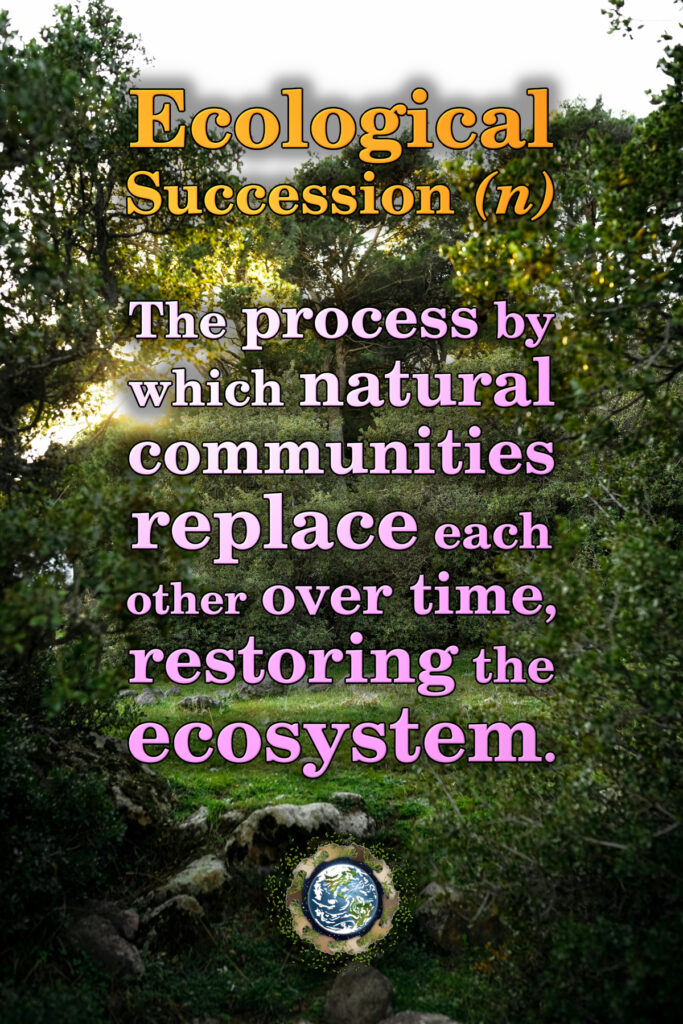
After disturbance, ecosystems don’t rebuild themselves all at once – they regenerate themselves piece by piece through a long-term process called ecological succession. Succinctly speaking, this is “the process by which natural communities replace (or ‘succeed’) one another over time.” (University of Chicago) This self-organizing pattern emerges and unfolds usually starting after a drastic event (fire, flood, human development, etc) has disturbed or degraded the land. Whether we start from an abandoned farm, the berm of a road cut, scars from fire, or outright wasteland, this process is how nature heals itself. Starting with the first pioneering species, complexity is layered in over time – and a community of plants, fungi, soil microbes and animal life are woven together. Humans can help this process along by assisting the scaffolding of this framework, provided care and attention are given to the given stages and steps are not missed. We can waste a lot of time, energy and money by trying to “jump the gun” and introduce species from the later stages when the preliminary groundwork has not yet been established. When plans are made and deployed with respect to this critical process, amazing things can happen and ecosystems rich with biomass and diversity can be established that then can improve themselves with time.
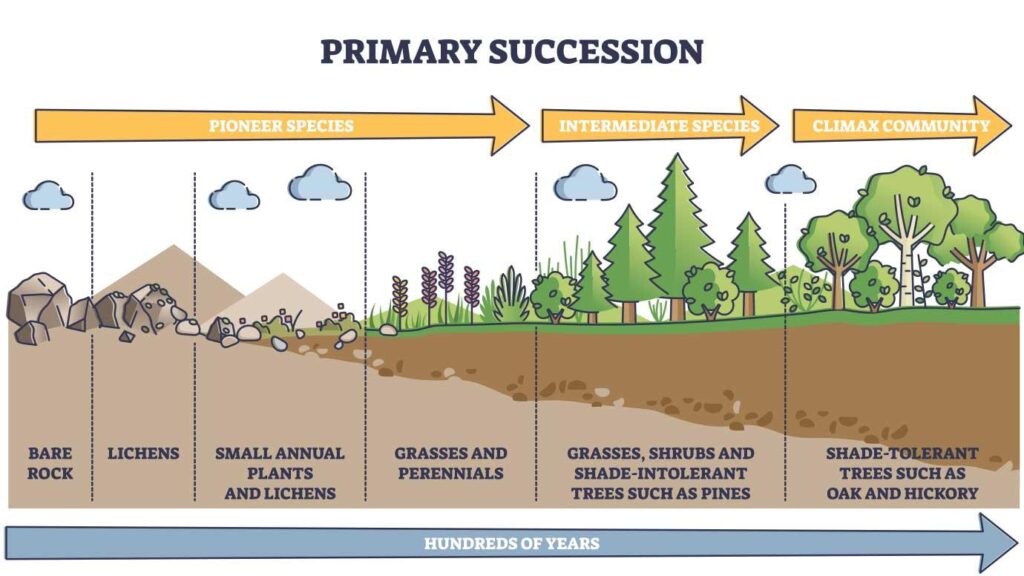
Succession is in essence nature’s strategy for increasing biomass, diversifying habitat and animal populations, deepening plant root systems, and improving the infiltration of water and the cycling of other nutrients, year over year. At the heart of this process is the concept of function, or the purpose that each species or element is serving to the others at every stage. Even though function and purpose are human concepts that we are applying to a non-human system, they help us organize the stages for the purpose of understanding them. Early pioneer species are sun-loving, fast-growing, and could be described as more “weedy” grasses, herbs and/or shrubs, sometimes even moss and lichens, who are the first to colonize disturbed ground or bare rock. They shade the soil and also begin to sequester carbon and nitrogen, opening up new channels for roots and creating the habitats and micro-climates that successive species will follow – all of which makes the area more habitable for life in general. As these become more established, more and more shade-tolerant plants with higher nutrient requirements will take advantage of the pioneering species “breaking ground” and move in – as can fungi, soil invertebrates, burrowing mammals, birds, and pollinators, in ever-increasing waves. Sooner or later, depending on ambient conditions and the deliberate efforts of any ecosystem restorationists that may be helping the process along, mid-story trees and woody perennials may move in, or be introduced – followed by, with more time passed, what will eventually be your larger canopy-forming trees.
With each passing wave of life establishing itself, by breaking new ground for root channels, shading new areas, and aided by the partial or complete decomposition of previous individuals, each plant community creates conditions that allow successive ones to thrive. And it’s not just about the number of species involved or some kind of strict time-wise function, but rather the rise of emergent feedback loops and interactions that collectively promote the resilience of the complete ecosystem. Here we have a video that we made where our founder and lifelong multi-forest-growing expert Michael Pilarski explains this process in more practical detail:
Hopefully you enjoyed that as much as we loved making it for you. As you can hopefully see, restoring structure, species and ecological function proceeds in stages, and “over time, complexity grows” as biomass increases and the organic matter and water held on-site goes up. In a sense, the art of ecosystem restoration mimics these stages of ecological succession, creating the structure that life can use to climb its way back to the canopy-tops of a forest. It’s important to note here also that not all spaces have been forests, or even “want to be” forests, and it’s important to pay attention to signs of what existed before, some of which may even need to come from soil samples and historical analysis of the site. Often this restoration process involves native species, but sometimes it can involve non-natives that can provide a ladder of sorts for the natives to climb and establish themselves on – this is especially true where the forest must provide both resources for people as well as habitat for other life-forms – of course, using any non-native species is a route that must be taken with great care in order to avoid even worse ecological disaster that can come from damaging invasive species. However, there are several examples in practice where non-native species plantations have provided the foothold that life needed to recover en masse.
We learn from succession that disturbance of ecosystems, such as fire, flood, and wind, is a natural process – not the enemy. Most areas have what is called a “disturbance regime” whereby a certain kind of disturbance is expected on a regular basis, to the point where certain species may not germinate without a wildfire, for example. A “climax community” – the highest density of biomass permitted on the site given the geological and climatic conditions – will remain intact until acted upon by either a natural or unnatural disturbance. Bio-regions across the world may consist of ecosystems in a myriad of states, depending on the most recent disturbance, with the mosaic-like tapestry of neighboring areas that remain undisturbed spilling over, through wind, mudslides, or animals dispersing seeds, into the affected area. Healthy areas where the soil nutrient content is high, root systems remain intact or root channels await new colonists, are more likely to bounce back sooner. As restoration practitioners, we can take a census of the state of a given property and get a sense of where our work should start – often enough, the species already on-site and the ones in the process of establishing themselves can give us a pretty clear idea where in the process things are. By and by, through combining the dynamic factors of root depth, canopy development, layering of species, microbial diversity and abundance, and water retention, we can nudge and accelerate the natural succession with our own efforts – therefore, ecosystem succession, and by extension ecosystem restoration, isn’t something we force, it’s a process we collaborate with.
Some helpful sources:
Max Witynski. 2025. University of Chicago. Ecological Succession, Explained. https://news.uchicago.edu/explainer/what-is-ecological-succession
Cynthia Chang. 2019. Journal of Ecology. Ecosystem restoration in a changing world. https://besjournals.onlinelibrary.wiley.com/doi/10.1111/1365-2745.13132
UN Decade on Ecosystem Restoration. 2025. What is Ecosystem Restoration? https://www.decadeonrestoration.org/what-ecosystem-restoration