All About Halophytes: What Role do Salt Tolerant Plants Play in Global Ecosystem Restoration?
Michael Pilarski. First edition. Originally Written January 31. 2022
Dear Earth Restoration friends,
I am doing research on halophytes and their role in global ecosystem restoration. Halophytes are salt-tolerant plants which are adapted to saline or alkaline situations. This includes mangroves, seashore plants and plants in inland saline deserts. These areas include an ever-growing extent of lands salted by irrigation and abandoned.
I have been studying how to restore salt-degraded ecosystems. There are pathways to restoration. Some of them include enough fresh water to flush the salts out of the topsoil, but water is increasingly scarce. So for the most part, our best strategy is to use halophytes as tools for restoration. Halophytes, properly managed, can increase organic matter and gradually ameliorate the situation so that species diversity and biological productivity can expand.
At the same time, how can we utilize halophyte plants to produce economic resources to support the people doing the rehabilitation?
The numbers of economic halophyte plants is large. Every region with saline habitats has native plants which can be used. Some non-native species can be used to advantage, either as pioneers, or part of long-term strategies. There are halophytes that are used for human food. This can include seeds and leaf protein.
Permaculture has studied and come up with strategies for saline lands. In some cases uplands have been deforested with a consequent reduction in absorption and transpiration of water in the upland and an increase of salty water making it to the lowlands, water tables rise and the soils are salted. For instance, this has happened in large parts of the Murray River Basin in Australia. Reforestation of the catchments is part of the solution in these cases. A more drastic and costly restoration is possible with compacted diversion channels to drain salted areas.
Many of the dryland, saline habitats of the world are used for grazing and many of them have been degraded. How can the grazing potential be restored and optimized?
Even seawater can be used for irrigating certain halophyte crops but usually it has to be done on sandy soils to keep the salts leached out of the top horizons. It is more difficult in low-permeability soils.
Halophytes are plants which can grow on salty soils. Some are tolerant and some are obligate. When we look at overall global ecosystem restoration needed, the role of saline habitats and halophytes play an important role, particularly in dryland habitats. The restoration backlog on salt-affected soils in the world is huge and increasing. Of the salt-affected lands in the world, many of them are natural phenomenon, so it isn’t as though we can restore them to some pre-salt status. Many of the world’s natural saline ecosystems have been degraded by human activities. We cannot restore them to a non-saline system but we can aim to return all ecosystems to the greatest state of health and biological productivity it is capable of. Below I give a few techniques for restoring soils salted by humans. This is a big topic and many people are working on this. Bravo to them and we need many more people working on this. Here are a few references from our library. More on this in the future.
The extent of primary (natural) salinization is estimated to be slightly under 1 billion hectares.
Extent of salt-affected soils
“Several authors have attempted to estimate the extent of salt-affected soils in the last 30 years, for example:
Using the FAO/UNESCO soil map of the world (1970-1980), FAO estimated that globally the total area of saline soils was 397 million ha and that of sodic soils 434 million ha. Of the then 230 million ha of irrigated land, 45 million ha (19.5 percent) were salt-affected soils; and of the almost 1 500 million ha of dryland agriculture, 32 million (2.1 percent) were salt-affected soils as indicated in the below table. Figures included arable and non arable soils.”
“The world is now losing annually about 1.5 million hectares of total irrigated lands (240 millions hectares) due mostly to salinization, mainly in drylands. Salt-affected soil are widely distributed throughout the arid and semi-arid regions and particularly severe in China (7 million ha), India 20 mlllion ha), Pakistan (3.2 million ha), USA (5.2 million ha), as well as Near East, southern Europe and elsewhere.” Halophytes as a Resource for Livestock and for Rehabilitation of Degraded Lands.
“Soil salinity is not a recent phenomenon, it has been reported since centuries where humanity and salinity have lived one aside the other. A good example is from Mesopotamia where the early civilizations first flourished and then failed due to human-induced salinization. A publication ‘Salt and silt in ancient Mesopotamian agriculture’ highlights the history of salinization in Mesopotamia where three episodes (earliest and most serious one affected Southern Iraq from 2400 BC until at least 1700 BC, a milder episode in Central Iraq occurred between 1200 and 900 BC, and the east of Baghdad, became salinized after 1200 AD) have been reported. There are reports clearly revealing that ‘many societies based on irrigated agriculture have failed’, e.g. Mesopotamia and the Viru valley of Peru. The flooding, over-irrigation, seepage, silting, and a rising water table have been reported the main causes of soil salinization. Recent statistics of global extent of soil salinization do not exist, however, various scientists reported extent differently based on different data sources, such as there have been reports like, 10% of the total arable land as being affected by salinity and sodicity, one billion hectares are covered with saline and/or sodic soils, and between 25% and 30% of irrigated lands are salt-affected and essentially commercially unproductive, global distribution of salt-affected soils are 954 million ha, FAO in 1988 presented 932 million ha salt-affected soils, of almost 1500 million ha of dryland agriculture, 32 million ha are salt-affected. Precise information on the recent estimates of global extent of salt-affected soils do not exist, many countries have assessed their soils and soil salinization at the national level, such as Kuwait, United Arab Emirates, Middle East, and Australia etc. Considering the current extent of salt-affected soils the cost of salt-induced land degradation in 2013 was $441 per hectare, a simple benefit transfer suggests the current annual economic losses could be $27 billion.” Abstract from:
Soil Salinity: Historical Perspectives and a World Overview of the Problem
https://link.springer.com/chapter/10.1007/978-3-319-96190-3_2
Saline and Alkaline Soils
The key difference between saline and alkaline soils is that saline soils have a pH less than 8.5 and an exchangeable sodium percentage less than 15, while alkaline soils have a pH greater than 8.5 and an exchangeable sodium percentage higher than 15. … Alkaline soils and saline soils are two types of basic soil
3 major categories of Halophyte Ecosystems
1) Mangrove swamps.
2) Coastline vegetation.
3) Inland saline and alkaline soils, natural and man-made
1) Mangrove swamps grow in sea-water but in most cases there is a freshwater input as well which create various levels of brackishness. Mangrove swamps are nurseries for many creatures of the sea. Mangroves protect coastlines, provide habitat and produce many things for human needs. Many mangrove ecosystems have been destroyed or damaged from human activity. Some mangrove species are browsed by camels in the Middle East and North Africa. Some places are overgrazed.
Early studies estimated that 35% of the world’s mangrove extent was lost between 1980 and 2000 [33], though the annual rate of mangrove forest loss slowed to an average of 0.26%–0.66% globally between 2000–2012 [34] and down to 0.13% between 2000–2016
The Mangrove Action Project is a great resource for mangrove conservation and restoration. Check out their website at https://mangroveactionproject.org/
Restoring The Natural Mangrove Forest
10:00. 48,388 views. Mar 21, 2019.
Global Assessments of Mangrove Losses and Degradation
https://www.iucn.org › files › content › documents
The Mangrove Restoration Potential Map (MRP Map) includes new assessments of the extent of mangrove losses and degradation since 1996,
2) Coastline vegetation. Seashores are salty habitats. Salt blows inland. Some species grow in the tidal zone and others just above it and bands beyond that.
3) Inland saline and alkaline soils, natural and man-made. Many of the world’s arid and semi-arid regions have salt-affected areas. Especially from using salty water for irrigation. Examples being the Euphrates River delta in Iraq, The Indus River delta in Pakistan and the Imperial Valley in Arizona. The list is long. There are many salt flats and salt lakes in areas with endorheic drainage. An endorheic basin is a drainage basin that allows no outflow to other external bodies of water, such as rivers or oceans.
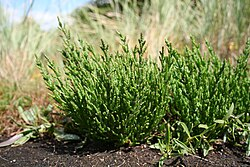
This particular paper focuses on the inland halophyte species. As one might expect certain genera can be found on both seashore and inland saline habitats. Two examples are:
1) The widespread Salicornia genus which has species in inland saline areas and also species which grow at ocean’s edge. I harvest and eat foliage here on the Olympic Peninsula in Washington State. Other Salicornia species have been selected as food crops for inland salt regions for their abundant seed production of an edible, safflower-like oil.
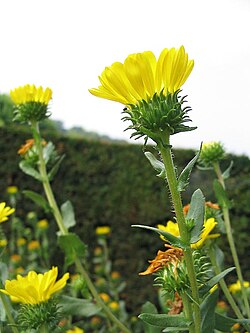
2) Grindelia species are found on the seashores of the Pacific coast of North America as well as inland saline habitats in Montana and the inland Northwest. Both species yield resins which have medicinal and industrial uses. “Grindelia camporum is a salt-tolerant resinous perennial shrub. It produces large amounts of aromatic resins that have properties similar to the terpenoids in wood and gum rosins, which are used commercially in adhesives, varnishes, paper sizings, printing inks, soaps and numerous other industrial applications” Saline Agriculture, page 15.
Some take-aways:
The Chenopodium family is one of the biggest families of halophytes.
Atriplex species, lambsquarter, quinoa. There are many edible brassicas from the seashore. One of the most important source of forage and fodder shrubs in drylands.
Casuarina species from Australia are useful pioneer plants in some situations
The Prosopis genus (Mesquite) includes some of the most used halophytes in the world.
Acacia is one of the most important halophyte genus of trees and shrubs in the world. Many Acacia seeds are rich in nutrients with high energy protein and contents.
Various salt-tolerant plants have been used for leaf protein productin including Kochia scoparia, Salsola kali (both widespread weeds), Beta maritima, Salicornia spp, Mesembryanthemum spp. and Atriplex spp.
Asparagus tolerates quite a bit of salt. Barley is more salt tolerant than wheat.
Here is a nice introduction to halophytes.
https://lifeofplant.blogspot.com/2011/03/halophytes.html
Here is a list of books in my library I have been researching in:
Saline Agriculture: Salt-tolerant Plants for Developing Countries. National Academy Press, Washington DC. 1990. 143 pages. Short overview of food, fuel, fodder, fiber and other products. Useful and affordable reference.
Diagnosis and Improvement of Saline and Alkali Soils. Ag Handbook No. 60. USDA US Salinity Laboratory staff. 1954. 160 pages.
Halophytes for Food Security in Dry lands.
Muhammed Ajmal Khan et al. 2016 Elsevier Press.. 338 pages.
Many technical papers. Some useful info to be gleaned about crops which would grow in salt-affected soils.
Reclamation of Solonets Soils in the USSR.
I.V. Tyurin, et al. Academy of Sciences of the USSR. 1967. Translated from Russian. Israel Program for Scientific Translations. 281 pages.
Halophytes as a Resource for Livestock and for Rehabilitation of Degraded Lands. Edited by Victor R. Squires and Ali T. Ayoub. 1994. Kluwer Academic Publishers. 314 pages. This is number 32 of a series of books called Tasks for Vegetation Science.
Land Degradation: Development and Breakdown of Terrestrial Environments. C.J. Barrow. 1991. Cambridge University Press. 295 pages. Pages 183 to 190 give a synopsis of salinization and alkalization and remedies.
Towards the Rational Use of High Salinity Tolerant Plants. Vol. 2. Agriculture and Forestry Under Marginal Soil Water Conditions.
H. Lieth and A.A. Al Masoom, editors. Kluwer Academic Publishers. 1993. 447 pages. This is number 28 of a series of books called Tasks for Vegetation Science. Lots of technical papers. One particularly useful paper is Studies on selection of salt-tolerant plants for food, fodder and fuel from world flora. They have some nice lists of forage and fuel plants for many countries.
For Iraq:
Forage species:
Cynodon dactylon
Sporobolus marginatus
Atriplex nummularia
A. lentiformis
A. halimus
A. amnicola
Salsola rigida
Maireana brevifolia
Fuelwood species
Tamarix articulata
T. aphylla
Acacia nilotica
All these species should be screened for use at Enduring Harvest.
This is a bare introduction to the very large topics of halophytes and restoration of saline ecosystems, with thousands of scientists worldwide working on this, and much scope for restoration efforts led by local populations.
Entertaining video
The Tumor of Sprawl, Remedied by Halophytes and Rare Cacti
33:07. 46,996 views. Apr 4, 2020.
Crime Pays but Botany Doesn’t. Perhaps my favorite botanist in the world. He travels around the world and takes you on plant walks with colorful commentary. 492 videos. 253,000 subscribers.
The promised land of Southern Utah – where the rednecks dance on cancerous housing developments, the cows shit chocolate and Pediocactus sileri grows on nearly barren gypsum hills. Gypsum endemic plants of Southern Utah quell the pain of life in this culturally bleak wasteland.