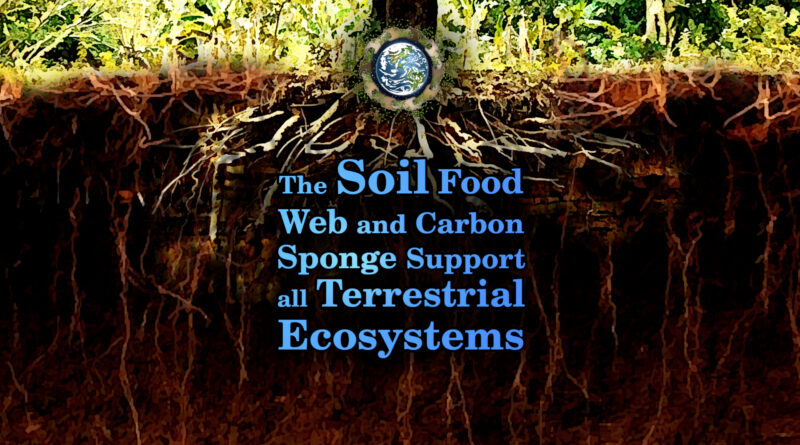
The Soil Food Web and Carbon Sponge: The Invisible Structure Supporting All Life on Earth
What if I told you that beneath your feet and all around you, a great and ancient intelligent network of living beings persisted, invisibly upholding its silent battle against the entropy and chaos that would otherwise tear our world apart at the seams? We sometimes take it for granted because it’s so prevalent, so seamlessly distributed in every nook and cranny of the surface of our planet, and its members so small (in fact, microscopic), efficient, and indistinguishable that it appears as a rich brown horizontal smear of, at its most basic level, some amount of everything – a substance so common that some call it, derisively or affectionately, “dirt”, “soil” or simply “earth” – I personally like the latter one, because it just gets straight to the point of it. But it’s not just a bunch of random decomposing junk – it is a fully functioning structure building microscopic cathedrals that help store potentially millions of gallons per acre of water and recharge aquifers?
With soil, we really are looking at the semi-permeable membrane, the literal skin of a giant living thing called the Earth, which is itself host to its own complex web of living things, with their own internal complex web of living things, and so the fractal continues, on down to the very molecules and atoms. Healthy soils are biodiverse, and fully biodiverse soils represent all the kingdoms of life on this planet, to the tune of potentially thousands of species in a single shovelful. There are more individual organisms in a single teaspoon of healthy soil than there are humans on the planet. So how do we ally with this network of living things to support it in its ancient struggle against chaos, how do we help it hold water, how do we help it support the web of life made of those larger, more visible co-inhabitants of Earth we are familiar with? And what does any of this have to do with stopping climate collapse, regenerating ecosystems and feeding the world?
Perhaps it’s more helpful to liken healthy soil to an advanced civilization – and that’s almost an insult, considering how inefficient and young our own is by comparison – teeming with builders, engineers, miners, recyclers, farmers, all interacting and working together to build the living structural matrix that supports everything we know. If you knew there was an advanced ancient civilization under your feet, with the wisdom and technology to stabilize the climate and save the world, wouldn’t YOU do everything you could to help it THRIVE? This question would seem hypothetical until you consider the amount of activity happening and the level of coordination involved. It’s a bit of a mess down there, but we’ve attempted to find some major categories here:
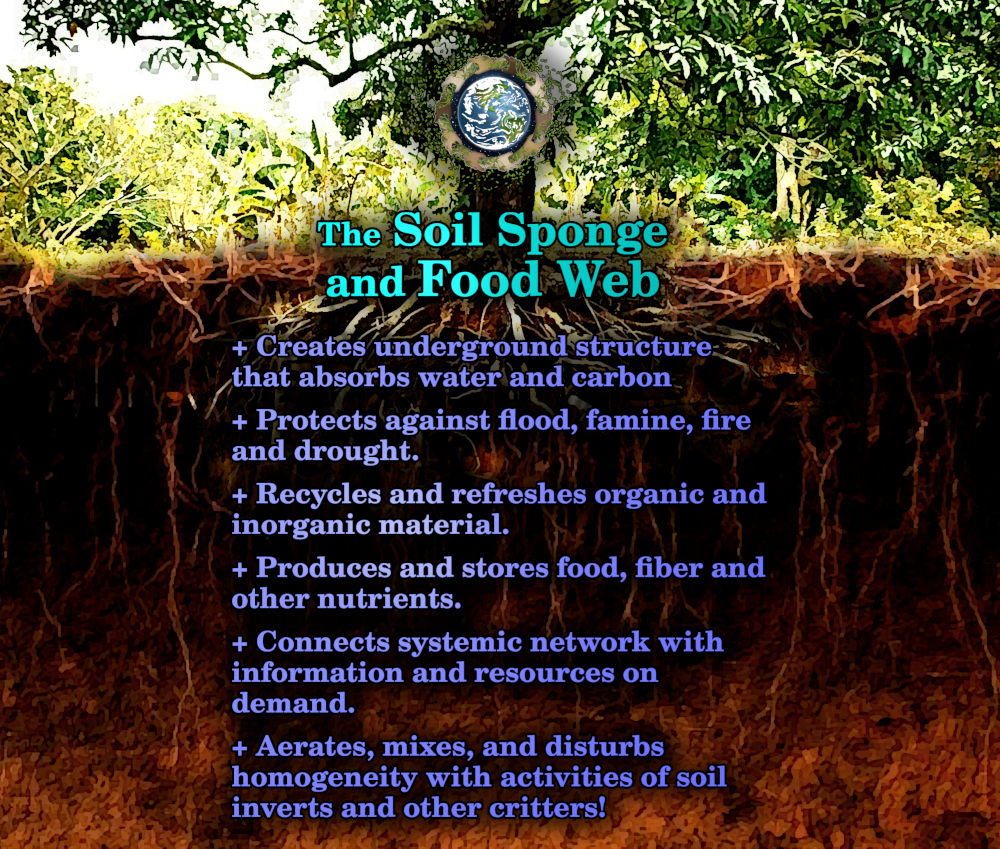
- Building and Engineering Crew: Mycorrhizal fungi, bacteria and root-exuding microbes, as well as the roots themselves, create structure that holds the soil together. Even after dying back, decomposing plant roots can leave channels which aerate the soil and allow traversal of soil invertebrates. Microbes extrude glues, threads and bio-films that bind mineral particles like sand, silt and clay together. This is the sponge in the “soil sponge” or it could be likened to the large buildings and scaffolding of an urban metropolis, within and upon which a multitude of activities can take place.
- Waste and Recycling Crew: The municipal waste crew of this micro-civilization is working around the clock to decompose organic materials, making the minerals they contain bio-available for the plants above. Such organisms, such as some protozoa, bacteria, fungi, and invertebrate micro-animals, shred and further pulverize leaf litter down to bio-polymers, mining the remains of other dead organisms – recycling carbon, nitrogen, water and other critical nutrients. Researchers of the “soil food web,” such as Dr. Elaine Ingham, have mapped out these interactions in great detail. Some have said that “the soil is a living creature that’s all mouth.”
- Farmers and Producers: Freely-distributed cyanobacteria photosynthesize near the surface and produce long complex molecules that help aggregate the soil, binding minerals and organics together. Symbiotic nitrogen-fixing bacteria gather that crucial element in specialized nodules attached to the roots of certain plants, most notably the legumes, providing a fertilizer source to plants without these adaptations. Of course, the plants themselves do photosynthesis and store sugars in their roots, which can be accessed by sub-soil invertebrates and microbes, sustaining the community even through non-productive times.
- Logistics and Networking: Mycorhizal fungi (yes, them again, they figure pretty prominently in this whole system) network plants together, surrounding and intimately connecting them by their roots. Through their webs of fuzzy angel-hair hyphae they distribute water, carbon and other nutrients, and even information, throughout the ecosystem directly. This is a big part of the subterranean communication and transportation system that’s come to be popularly called the “wood wide web.”
- Major Infrastructure Construction / Demolition: Larger macroscopic organisms from earthworms to beetles to small mammals like voles or moles build and dig channels through soil and rip up live or decaying vegetable matter, creating channels for air and water. This creates highways, chasms and pockets for other smaller creatures to traverse and occupy, but also the holes in the proverbial “sponge” that hold more moisture. The slime from earthworms helps further aggregate the soil where they have traversed.
You might notice that these different functional groups have some cross-over. Some groups of organisms cross over between the different categories, performing many different ecosystem services. This also dovetails with the permaculture principle “stacking functions”, which is the idea that a given element in a system or design serve as many purposes simultaneously as possible. Of course the big picture we really take out of all of this is a complex structure of lots of scaffolding, highrises, tunnels, depots, and conduits. At a distance, however, the details blend together and it really does just end up taking that spongy appearance. The sponge is more than just looks, though – it absorbs rain, storing water and reducing flooding from runoff. It also filters the water with the full force of dense layers of diverse biology, and cools landscapes both by holding all that rainwate, resisting fire and drought and supporting the plants that transpire moisture between its liquid and gaseous states – evaporation has a cooling effect. Meanwhile, it is all sequestering and stabilizing carbon in all its forms, from living plants all the way down to the rich brown humus.
Below is a video from Walter Jehne on his “Soil Carbon Sponge ABCD” as well as some further reading on all this and more:
Nawaz, T., Saud, S., Gu, L., Khan, I., Fahad, S., & Zhou, R. (2024). Cyanobacteria: Harnessing the power of microorganisms for plant growth promotion, stress alleviation, and phytoremediation in the era of sustainable agriculture. Plant Stress. https://www.sciencedirect.com/science/article/pii/S2667064X24000538
Pershouse, D. (2019, April 2). Why communities should invest in regenerative agriculture and the soil sponge. Medium. https://didipershouse.medium.com/why-communities-should-invest-in-regenerative-agriculture-and-the-soil-sponge-431c27c8b34b
Pershouse, D. (n.d.). Soil health principles. Didi Pershouse. https://www.didipershouse.com/soil-health-principles.html
Pershouse, D. (2017). World Soil Day 2017 statement. Food and Agriculture Organization of the United Nations. https://www.fao.org/fileadmin/templates/lon/World_Soil_Day_2017/UN_Didi_Pershouse_World_Soil_Day_2017__Statement_FINAL.pdf
Soil carbon sponge. (n.d.). In Wikipedia. https://en.wikipedia.org/wiki/Soil_carbon_sponge
Joe Gardener. (n.d.). Understanding the Soil Food Web [Audio podcast episode]. JoeGardener.com. https://joegardener.com/podcast/understanding-the-soil-food-web/
Regenerate Earth. (n.d.). Walter Jehne’s soil carbon sponge ABCD. https://regenerate-earth.org/walter-jehnes-soil-carbon-sponge-abcd/
Haskell, D. (2016). The whispering trees. Smithsonian Magazine. https://www.smithsonianmag.com/science-nature/the-whispering-trees-180968084/
Global Earth Repair Foundation. (n.d.). Elaine Ingham. https://globalearthrepairfoundation.org/elaine-ingham/