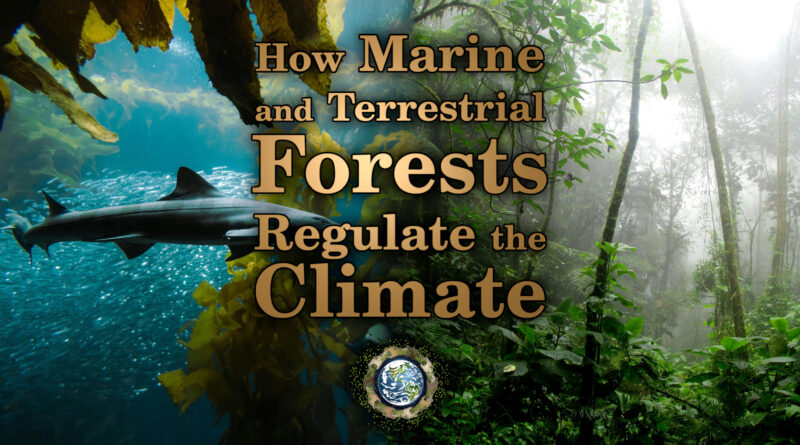
Terrestrial and Marine Forests Work Hand in Hand to Maintain the Climate Far Beyond Mere Carbon Sequestration
Living ecosystems cool the planet in so many ways – yes, they sequester carbon, but it’s so much more multidimensional than that. Forests both marine and terrestrial influence temperature, cloud formation and precipitation en masse by directly manipulating the physical interplay of energy, water, and living aerosol particulates (like spores, micro-algae, and pollen). These virtuous feedback loops include but are not limited to only-recently-hypothesized effects like the “biotic pump” and “aerial rivers” use evapotranspiration, photosynthesis and bio-aerosols to nucleate clouds and control the states of water, resisting the march of entropy over sea and land and maintaining the balance of climate locally – and when bio-regional systems can be repaired and linked together, we get positive global change. In other words, forests of both kinds are the planetary thermostat, and the good news is – we can improve the chances of both to thrive!
Following are a list of important ways that these ecosystems work hand in hand to bring us holistic climate balance as well as natural abundance for all creatures, humanity included:
Terrestrial Forests
1. Evapotranspiration drives regional cooling.
Trees absorb soil moisture and release it via transpiration and evaporation, which cools the surrounding landscape and lifts moisture into the atmosphere. (Ellison et al., 2017)
2. The biotic pump — forests draw ocean moisture inland.
Large forested regions create low-pressure by controlling fluctuation between evaporation and condensation. This draws moist air from the ocean and sustains rainfall inland. (Makarieva & Gorshkov, 2007)
3. The Small Water Cycle – Aerial rivers & moisture recycling from forest connectivity.
Forests help move rainfall inland far from the coast by maintaining “aerial rivers”, connected conduits of moisture sustained by evapotranspiration. (Muys et al., 2019)
4. Forest-emitted bioaerosols seed clouds and make rain.
Vegetation helps clouds form by releasing biological particles and short-lived volatile compounds that become cloud condensation nuclei (CCN) or ice-nucleating particles (INP), aiding in shade and delivering precipitation (Després et al., 2012).
5. Canopy shading & surface albedo effect reduce heat flux.
Forest canopies lower surface temperatures by shading the soil, dappling light. Photosynthesis reduces the light directly absorbed by the Earth, driving it toward the fixation of more biomass instead and reducing heat flux into the atmosphere. (Ellison et al., 2017)
6. Soils stabilize climate by storing water and buffering extremes.
Forests and the soils they sustain reduce wild changes in temperature by storing and slowly releasing water, as well as controlling surface runoff and sustaining underground flows, such as springs. (Kravčík et al., 2017)
Marine Kelp & Oceanic Systems
1. Kelp forests moderate evaporation of the sea near the surface and cool the local climate.
The local atmosphere is cooled when dense mats of kelp and other macro-algae modify the evaporation patterns on the surface, when compared to baseline conditions. This impacts the exchange of heat between the sea and surrounding air on a regional scale. (von Herzen, Climate Foundation)
2. Bio-aerosols created by marine life help form clouds through sea spray.
When crashing wave tips turn to sea spray, it contains biological particulates – similar to those from terrestrial forests – consisting of living micro-organisms as well as marine micro-debris. These contribute to the same kind of cloud nucleation (CCN’s and INP’s) as in their land-based counterparts. (Kawana et al., 2024)
3. Human-assisted operations amplify the climate-control effects of kelp forests.
Marine layers, coastal cloud formation, and other cooling processes may be increased by intensive cultivation or restoration of kelp forests. This is because more kelp generates more aerosols and assists with a variety of surface cooling effects. (von Herzen & Climate Foundation)
4. The natural weather link between land and sea is maintained.
Rainfall patterns over the lands near coasts that are lush with marine forests are more regular because bioaerosols maintain the cloud cover and precipitation levels. (Kawana et al., 2024)
Forests and kelp together reveal that the Earth’s cooling system is biological as much as physical. Vegetation and marine life drive water cycling, cloud dynamics, and energy exchange—stabilizing temperatures and rainfall patterns that carbon accounting alone cannot explain. Restoring these living systems restores the climate’s natural regulation, reconnecting the carbon, water, and energy cycles that sustain a habitable planet.
Restoring the living systems of land and sea – whether we’re talking about rainforests, chaparral, coral reefs, or kelp forests, sustains a habitable planet by maintaining the climate’s natural regulatory systems. Doing so, we re-connect the cycles of water, energy, and carbon, and also stabilize rainfall patterns that sustain human life and the natural world around us. The fact that this also helps maintain the temperature and climate of whole regions, and the Earth as a whole, is icing on the cake.
We can start to see how the Earth’s cooling system is a function of the beating heart and living mind of biology itself, and by promoting healthy and biodiverse ecosystems can only help restore balance to the planet. If you are interested in getting involved in any of these efforts, reach out to the scientists mentioned in these resources – many of whom we are working with directly – or get involved in the preparation of the Global Earth Repair Convergence in May 2026, when we will be discussing implementation of all these strategies and more.
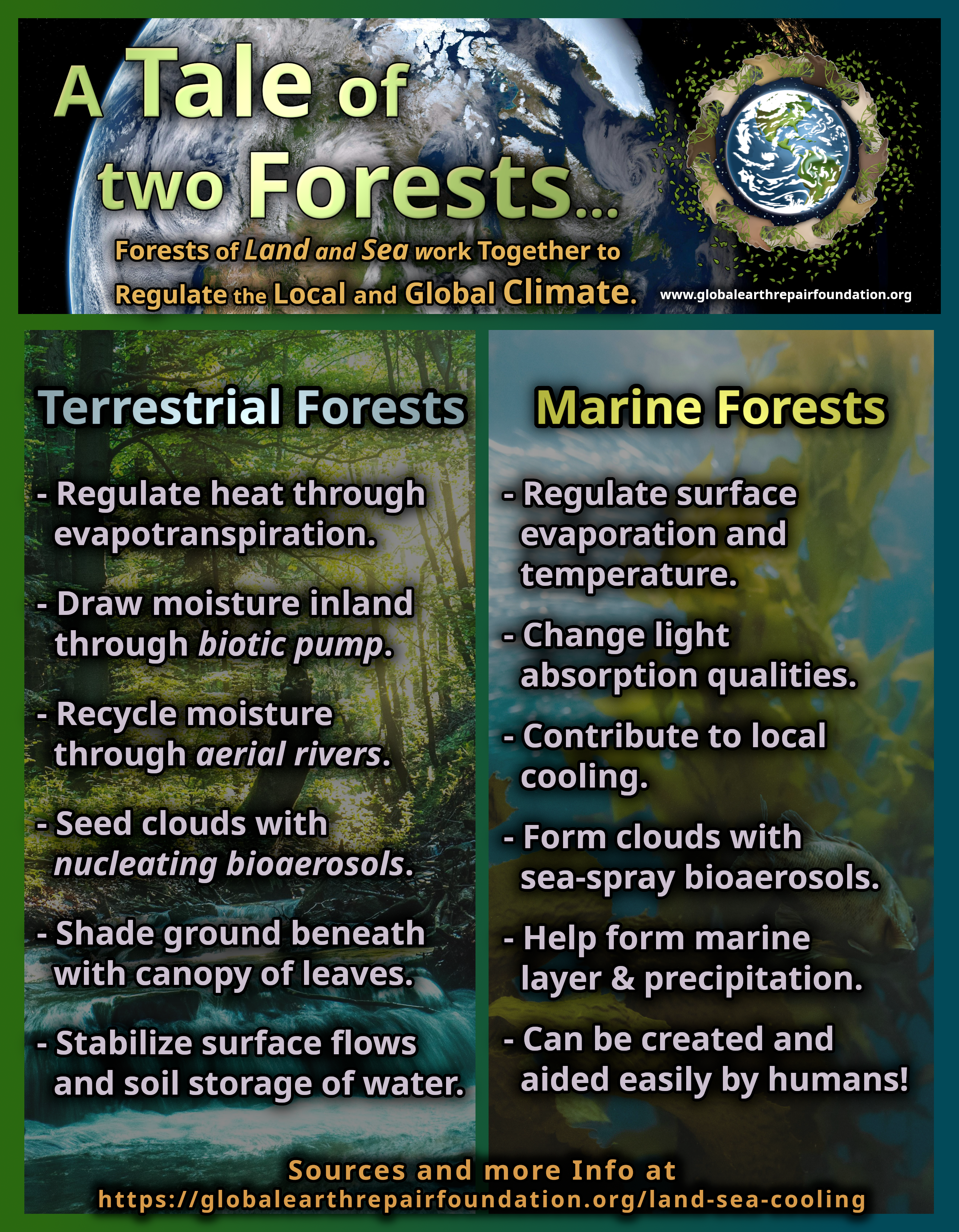
Have a printer or social media platform and want to spread the word? Download and print out or share the following infographic poster to spread the good news about the regulating effect forests of all kinds have on global climate!
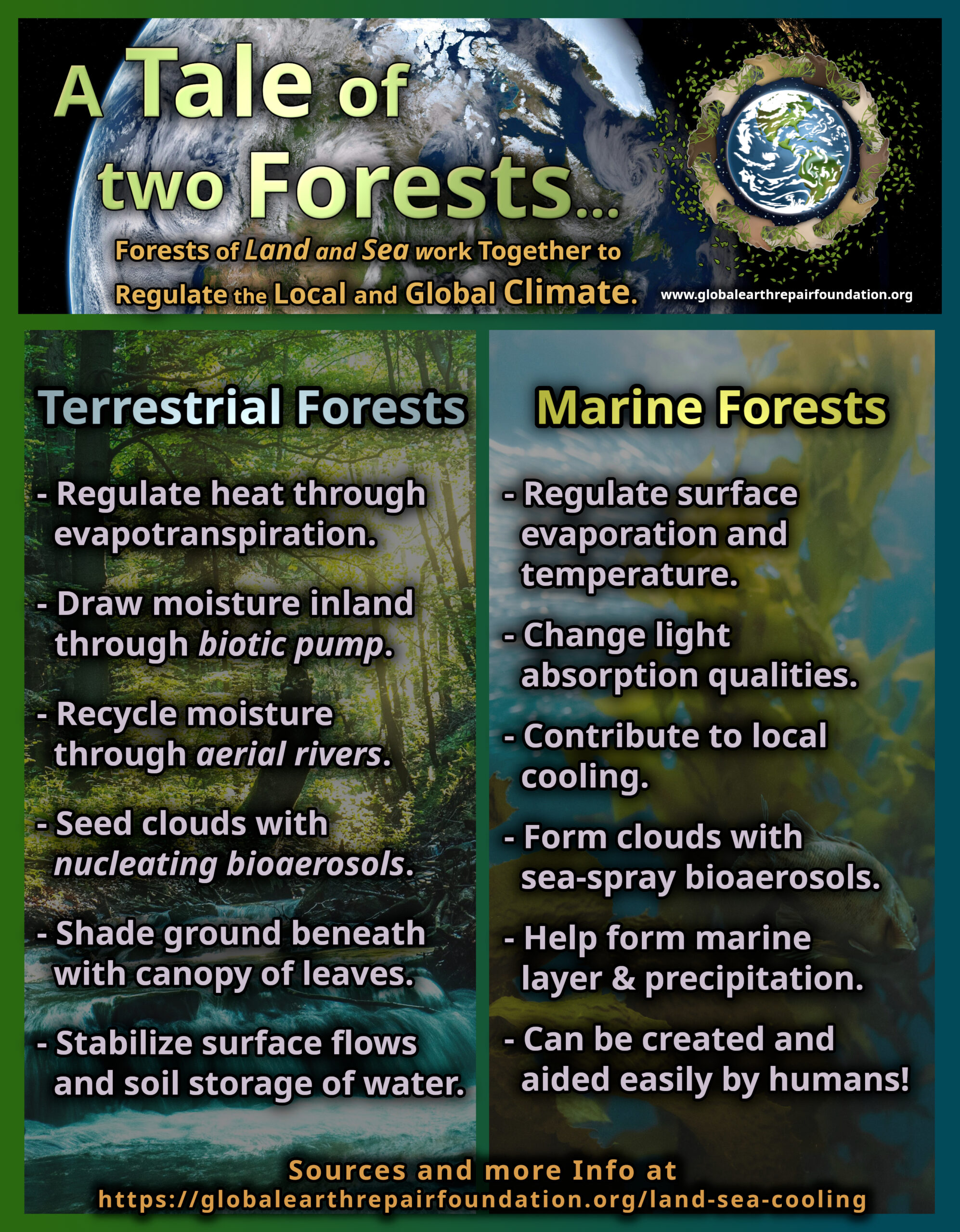
Full resolution download below:
References
- Ellison, D., et al. (2017). Trees, forests and water: Cool insights for a hot world. Global Environmental Change, 43, 51-61. https://doi.org/10.1016/j.gloenvcha.2017.01.002
- Makarieva, A. M., & Gorshkov, V. G. (2007). Biotic pump of atmospheric moisture as driver of the hydrological cycle on land. Hydrology and Earth System Sciences, 11(4), 1013–1033. https://doi.org/10.5194/hess-11-1013-2007
- Muys, B., et al. (2019). What role do forests play in the water cycle? European Forest Institute Q&A. https://efi.int/forestquestions/q7
- Després, V. R., et al. (2012). Primary biological aerosol particles in the atmosphere: A review. Tellus B: Chemical and Physical Meteorology, 64, Article 15598. https://doi.org/10.3402/tellusb.v64i0.15598
- Kravčík, M., Pokorný, J., Kohutiar, J., Kovác, M., & Tóth, E. (2017). Water for the Recovery of the Climate: A New Water Paradigm. People & Water NGO. https://www.ctahr.hawaii.edu/hawaiirain/Library/papers/Non-conference%20papers/Book%20-%20Water%20for%20the%20recovery%20of%20the%20planet.pdf
- von Herzen, B., & Climate Foundation. (n.d.). Marine Permaculture. https://www.climatefoundation.org/marine-permaculture.html
- Kawana, K., Kanaya, Y., et al. (2024). Roles of marine biota in the formation of atmospheric bioaerosols, CCNs and INPs. Atmospheric Chemistry and Physics, 24(3), 1777-1799. https://doi.org/10.5194/acp-24-1777-2024